

California Initiative to Advance Precision Medicine Building an Affirming Life and Navigating Challenging Emotions (Balance Study)(2024-2027)
Depression Research Program demonstration project led by Dr. Greg Hajcak, PhD, Santa Clara University (SCU)
Project Summary
This project seeks to:
Background
Twenty percent of all youth experience depression, leading the U.S. Surgeon General to declare in 2021 that there is a youth mental health crisis.
To address youth mental health, the SCU team seeks to develop a youth-centered digital application and pair this app with online peer support to meet youth where they are (online, and with near-aged peers) to reduce depressive symptoms with a personalized approach. The intervention will test the impact of the digital app and peer support on increasing resilience to stress (e.g., help youth to externalize and reduce internalized forms of stress), decreasing negative emotions, and increasing positive emotions.
Additionally, 25% of youth identify as LGBTQ+ and experience social stigma, rejection and victimization related to their marginalized sexual identities. Youth with LGBTQ+ identities are twice as likely to experience depression and are among the least likely to receive mental health services, despite the increased need. Current youth mental health resources rarely integrate identity-affirming practices, and digital mental health tools frequently lack LGBTQ+-specific content, crisis pathways, privacy protections, or communication approaches appropriate to gender exploration and identity disclosure.
To address these gaps and reduce youth mental health disparities, the team will recruit a Youth Advisory Board (YAB) to inform development of materials and resources. The digital app will also be specifically designed to address depression and vulnerability to depression among LGBTQ+ youth and peer counselors will be trained with those practices. The team will work with community partner Alum Rock Counselor Center and private sector collaborators Wellspace (i.e., Peers.net), Muse, and Colibri Digital Marketing to recruit youth (ages 14-19) in an online, remote study, with the goal of improving mental health equity for all youth, including LGBTQ+ youth, by providing culturally-responsive, developmentally-appropriate support mechanisms that address both depressive symptoms and the specific stressors associated with LGBTQ+ identities.
Project Goals
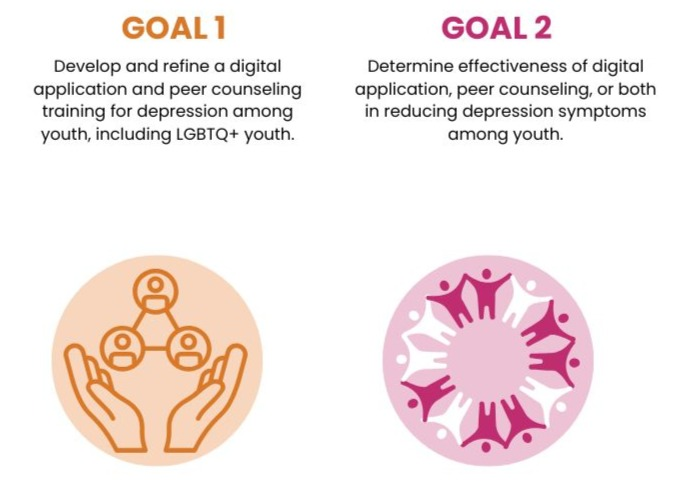
- Develop and refine a digital application and peer counseling training materials for depression among youth, including LGBTQ+ youth
- Conduct YAB sessions and iteratively incorporate feedback to guide digital application structure and content, peer counseling training materials, safety features, and identity-affirming content.
- Determine effectiveness of digital application and peer counseling in reducing depressive symptoms among youth
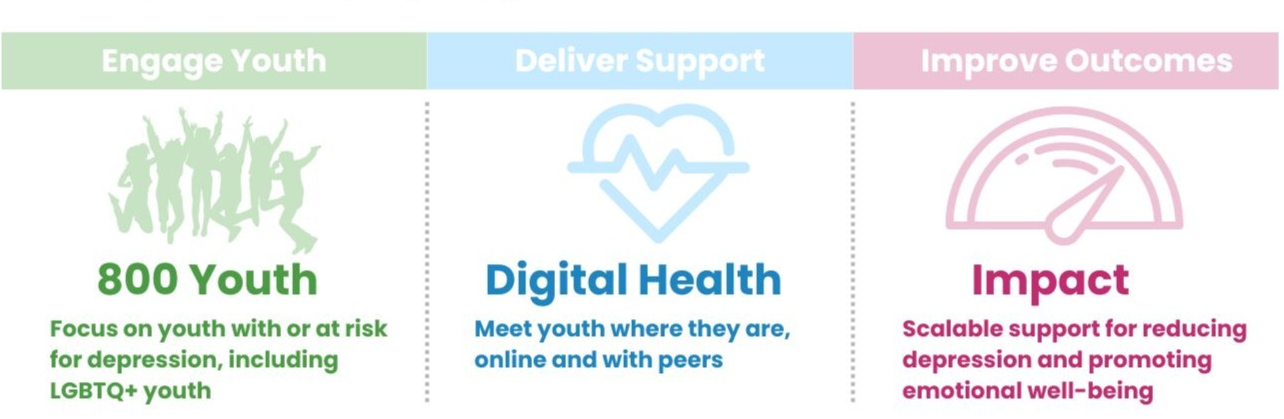
- Enroll up to 800 youth, with at least 50% identifying as LGBTQ+, in an 8-week study to assess effectiveness of intervention in reducing depressive symptoms and biological or physiological stress measures
Method:
Develop and refine a personalized digital application for youth with depression or at elevated risk, and develop training materials for peer counselors supporting LGBTQ+ youth.
Community Partnerships:
SCU's project aims to provide support for youth mental health and their elevated risks for depression. The SCU team partners with the Alum Rock Counseling Center (ARCC) to aid in study recruitment. ARCC is a mental health resource center that supports the SCU team in facilitating the Youth Advisory Board (YAB), which is comprised of members from local high schools and youth across California. The YAB provides feedback on the SCU team’s intervention materials. In addition, ARCC is hosting an Outreach Coordinator who dedicates effort towards community outreach and the recruitment of participants for the research study from other counseling centers and organizations.
Private Sector Collaborations:
MUSE is the developer of the digital application used for the project. MUSE has been working closely with the SCU team in applying high-quality, psychoeducation content while also incorporating changes that the YAB has suggested to ensure that the app is tailored to the community in various aspects, such as color scheme, language use, and functionality.
Peers.net (part of Wellspace) is the platform that facilitates the peer support portion of the study. The SCU team has been working with Peers.net in designing the training content that incorporates audio and animations to educate on how to provide affirmative support to LGBTQ+ youth.
Colibri Digital Marketing is an LGBTQ+ and woman-owned marketing team to help with recruitment and outreach to LGBTQ+ communities and online spaces to widen the reach of the SCU project across California.
Potential for Impact for Californians: California youth, including LGBTQ+ youth, will benefit from the integration of a scalable, identity-affirming digital mental health platform, paired with peer counseling, to reduce or prevent depressive symptoms.
Definitions
Adolescents and young adults who identify as lesbian, gay, bisexual, transgender, queer, or gender diverse who experience a disproportionate burden of depression, suicidality, and chronic stress due to social stigma, discrimination, identity-based victimization, and inequitable access to mental health resources.
A framework describing how stigma, discrimination, identity concealment, and expectations of rejection create chronic social stress specific to sexual and gender minority populations, which accumulates over time and directly increases vulnerability to depression and adverse health outcomes.
The process of successfully adapting to difficult or challenging life experiences, especially through mental, emotional, and behavioral adjustments to external and internal demands.
A structured-support approach in which trained near-age peers provide emotional support, affirmation, guidance, and referral pathways using communication strategies that are culturally-responsive and developmentally-appropriate for Peer+ youth.
Team Leaders
Santa Clara University, Clinical Psychologist
Dr. Hajcak is a licensed Clinical Psychologist, whose research has involved large and longitudinal studies to better understand the development of anxiety and depression among adolescents and young adults—focusing on valid and reliable EEG/ERP biomarkers of brain function.
His research has involved large and longitudinal studies to better understand the development of anxiety and depression among adolescents and young adults; this work has established a number of neural biomarkers of risk for anxiety and depression. He has received continuous funding from the National Institute of Mental Health (NIMH) since 2000 (PI or Co-I on 20+ grants) and has published more than 375 peer-reviewed papers.
Dr. Hajcak has also received many awards, such as the Distinguished Scientific Award for Early Career Contributions to Psychology from the American Psychological Association (2016), the Janet Taylor Spence Award for Transformative Early Career Contributions from the Association for Psychological Science (2012), and the Distinguished Scientific Award for Early Career Contributions to Psychophysiology (2012). He earned his Ph.D. in Clinical Psychology from the University of Delaware and was Professor of Psychology at Florida State University and Stony Brook University before joining the faculty at Santa Clara University.
Dr. Alley is a developmental health psychologist and postdoctoral fellow at the University of California, Los Angeles. Her research explores how social determinants of health and systems of inequality—particularly those affecting LGBTQ+ communities—shape health and development. Dr. Alley earned her Ph.D. in Developmental Psychology from the University of Utah.
Ms. Chun currently serves as the Director of the Community Services Unit at Alum Rock Counseling Center in San Jose. She brings over a decade of experience in program management, volunteer coordination, event coordination, and wellness and educational support. Ms. Chun’s work has focused on supporting and empowering communities, youth, and families.
Dr. Feinstein is a Professor in the Department of Psychology at the Rosalind Franklin University of Medicine and Science, where he directs the Sexuality, Health, and Gender (SHAG) Lab. Dr. Feinstein obtained a Ph.D. in clinical psychology from Stony Brook University, completed a clinical internship at the University of Washington School of Medicine, and a postdoctoral fellowship at the Feinberg School of Medicine at Northwestern University. His current line of research focuses on sexual and gender minority (SGM) health, bisexuality and pansexuality, stigma-related stress and coping, and developing and testing interventions to improve SGM health.
Dr. Pachankis directs Yale’s LGBTQ+ Mental Health Initiative, which serves as a home for scholarship devoted to understanding and improving the mental health of LGBTQ+ populations in the US and around the world. Dr. Pachankis earned his Ph.D. from SUNY Stony Brook in clinical psychology and completed a clinical internship at McLean Hospital/Harvard Medical School. His National Institutes of Health (NIH)-funded research program examines the efficacy of LGBTQ+-affirmative mental health interventions delivered via novel technologies, in diverse settings, and across the spectrum of the LGBTQ+ community.
Founding Director, Laboratory for Stress Assessment and Research
Investigator, Staglin One Mind Center for Cognitive Neuroscience
Research Scientist, Semel Institute for Neuroscience and Human Behavior
Dr. Slavich’s research focuses on the conceptualization, assessment, and management of life stress; psychological and biological mechanisms linking stress with mental and physical health; and systems and policies for reducing population-level health disparities caused by stress and adversity. Dr. Slavich earned his Ph.D. in clinical psychology from the University of Oregon, completed a clinical internship at McLean Hospital and a clinical fellowship in the Department of Psychiatry at Harvard Medical School, and postdoctoral fellowships in psychoneuroimmunology at UCSF and UCLA.
Dr. Wei is an Assistant Professor and Coordinator for the LGBTQ+ Emphasis in the Counseling Psychology Department at Santa Clara University. His research broadly aims to address health disparities affecting sexual and gender minority populations with multiple marginalized identities and/or those living in developing countries, by understanding the intersectional nature of discrimination/oppression and designing culturally affirming-interventions (e.g., mindfulness). Dr. Wei earned his PhD in Counseling, Clinical and School Psychology at the University of California, Santa Barbara, and completed his pre-doctoral Clinical Psychology internship at Richard J. Donovan State Prison.
Partners, Collaborators, and Supporters
- Weill Cornell Medical College
- Dimitris Kiosses, Ph.D.
- UCLA
- Jeffrey Gassen, Ph.D.
- Chapman University
- Valentyna Simon
- SCU
- Anabel Dorfman
- UCLA
- Summer Mengelkoch
- SCU
- Danielle Jones
- CalPride
- UC Berkeley
- Keenan Joyner