

California Initiative to Advance Precision Medicine Making the Unseen Seen Trial of Depression (MUST-D): Scrutinizing social determinants of depression to advance precision and equitable care (2024-2027)
Depression Research Program demonstration project led by Dr. Suzi Hong, PhD, University of California San Diego (UCSD)
Project Summary
This project seeks to:
Background
Due to limited workforce capacity, resources, and evidence-based guidance, most mental health care systems do not assess or address patients’ social and environmental contexts.
Social determinants of health (SDoH), such as housing insecurity, economic instability, limited education or job opportunities, unsafe neighborhoods, food insecurity, and lack of social support exert a powerful influence over mental health. Marginalized communities, defined by race/ethnicity, low income, immigrant status, housing instability, or other structurally disadvantaged positions, are disproportionately exposed to adverse SDoH and thus at heightened risk for poor mental health outcomes.
Working towards the wellness of such communities requires cultural sensitivity – the ability for a healthcare or research system to recognize, respect, and respond appropriately to the cultural identities, values, communication styles, and lived experiences of the patients it serves.
The UCSD team, in partnership with the Family Health Centers of San Diego (FHCSD; a large federally qualified health center serving marginalized communities), the community-based advocacy organization Global Action Research Network, and a private-sector collaborator, NeuroUX, to address this critical need of reducing mental health disparities.
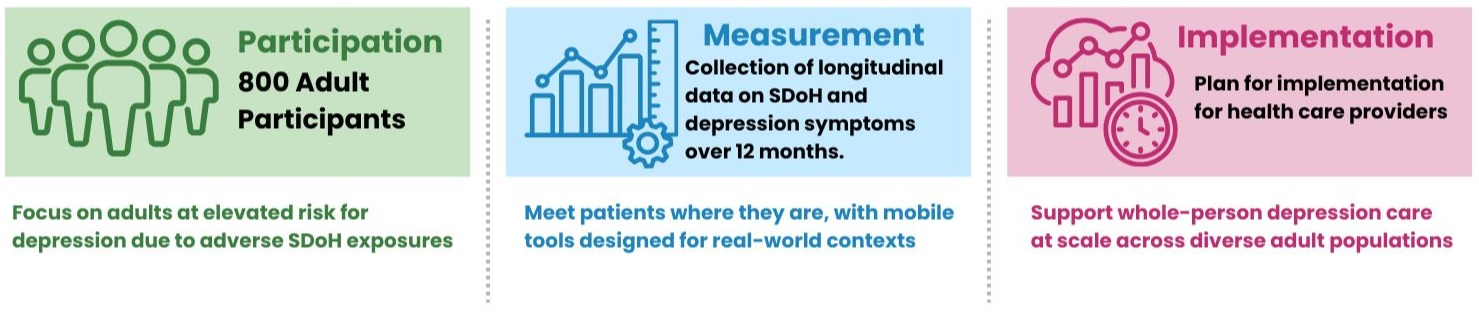
The team will engage a Community Advisory Board (CAB) to inform the development of the project and collect longitudinal data on SDoH and depression symptoms of patients receiving care at FHCSD over 12 months to characterize how social and environmental conditions influence depression outcomes over time, identify critical risk and resilience factors, and generate insights to inform socially-responsive, precision depression care, at-scale, for diverse adult populations.
Project Goals
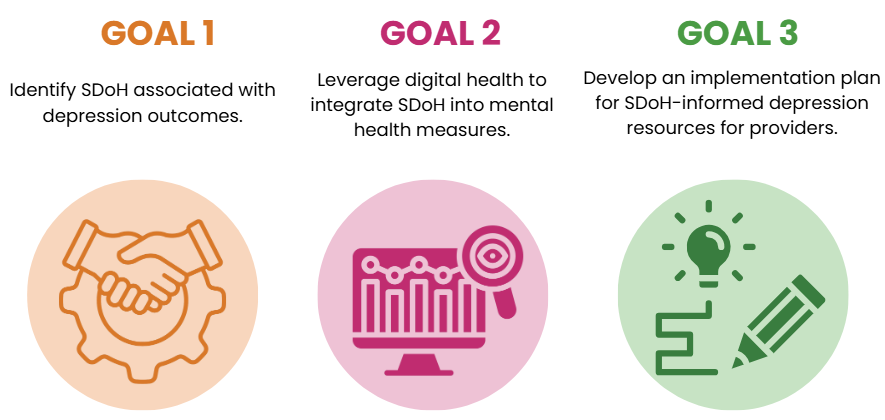
- Identify SDoH strongly associated with depression outcomes.
- Work collaboratively and iteratively with CAB to inform framing and development of SDoH/depression outcome survey questions
- Characterize which social, economic, and environmental factors predict onset, severity, remission, or relapse of depressive symptoms over 12 months.
- Leverage digital health to integrate SDoH into mental health measures.
- Refine and deploy a smartphone-based platform to collect bi-monthly, real-world data on time-varying SDoH and depression symptoms, and produce culturally sensitive, patient-centered data.
- Evaluate the feasibility, acceptability, and data quality of integrating SDoH monitoring into routine community-clinical care through FHCSD.
- Explore to characterize depressive symptoms as related to SDoH
- Develop an implementation plan for SDoH-informed depression resources for providers.
- Co-design, with providers, CAB, and patients, a suite of tools, including: clinical workflows, digital templates, decision aids, and care pathways that incorporate SDoH in assessment and treatment planning.
- Pilot the implementation of these resources, with participating clinics, to assess usability, acceptability, and impact on care processes.
Method:
Improve equitable depression care and outcomes by uncovering time-varying effects of SDoH on depression among the most socially vulnerable.
Community Partnerships:
The UCSD team is partnering with Family Health Centers of San Diego and Global Action Research Center to build a culturally sensitive mobile survey platform to answer research questions on SDoH for depression and clinician resources that support clinical workflows which incorporate SDoH.
Family Health Centers of San Diego (FHCSD) coordinates and engages key partners (for example, clinical providers, administrative personnel, data engineers, and patient health navigators) on SDoH needs assessments, clinical depression care and outcomes. The UCSD team and FHCSD are also working together to continue engaging patient representatives in the community advisory board (CAB), to provide feedback for the design of survey questions and the mobile platform used for the research study. With the FHCSD team and the CAB, the UCSD team is also collaborating on the development of an ‘Implementation Playbook’ that guides clinicians’ care decisions and referrals, with SDoH that affect depression outcomes in mind.
Global Action Research Center is a community-based advocacy organization that has been supporting formation of the CAB, as well as facilitating CAB meetings and synthesizing the rich qualitative data that has arisen from these sessions
Private Sector Collaborations:
NeuroUX specializes in mobile survey assessments to capture neurobehavioral factors in daily life. NeuroUX is working closely with the UCSD team and the CAB in building, piloting, and disseminating the survey platform for the research study.
Potential for Impact for Californians:
Patients will benefit from the development of a sustainable precision medicine approach to whole-person depression care in diverse, vulnerable populations that considers SDoH for depression, offering a scalable model for integrating SDoH into mental health care across California and beyond.
Definitions
the non-medical social, economic, and environmental conditions in which people are born, grow, live, work, and age; includes structural factors such as housing, income, education, neighborhood, social support, and community context.
communities experiencing structural disadvantage (e.g., due to race/ethnicity, income, immigration status, housing instability, neighborhood disadvantage, or limited access to resources) and therefore heightened exposure to adverse SDoH.
Team Leaders
Dr. Hong is currently a Professor at the UCSD Schools of Public Health and Medicine and the Director of the UCSD Integrative Health and Mind-Body Biomarker Core. Dr. Hong’s research interests include neuroendocrine and immune cell activation, exercise and immune system activation and adaptation, and inflammation and its cognitive and psychosocial impact. Her National Institutes of Health (NIH)-funded studies have been focusing on immune cell activation and inflammation under sympathoadrenal activation among individuals living with chronic inflammatory conditions and their implications for cardiovascular, neuropsychiatric, and cognitive outcomes. Her recent research projects also include investigations of multi-system risk factors for cognitive outcomes in older adults and depression among individuals living in socially under-resourced settings. She earned her PhD in psychoneuroimmunology and exercise immunology from the University of Georgia, then completed her post-doctoral training in psychoneuroimmunology and behavioral medicine research in the UCSD Department of Psychiatry.
Dr. Emily (Ema) Troyer is an Associate Clinical Professor, Director of the Community Psychiatry Research Center, and Community Psychiatry Track Director for the Child and Adolescent Psychiatry Fellowship, in the UCSD Department of Psychiatry. Under her direction, the Community Psychiatry Research Center is focused on understanding social drivers of health for individuals living with mental illness who receive care in publicly funded systems of care. She is passionate about building and maintaining strong academic-community partnerships between the UCSD Community Psychiatry Program, local Federally Qualified Health Centers, and San Diego County specialty mental health programs, as well as mentoring trainees in these settings, to develop the future workforce of clinician-scholars in community-based, public-sector systems of care. Dr. Troyer earned her M.D. at the University of Toledo in Ohio, followed by general psychiatry residency training at the University of Illinois at Chicago, child and adolescent psychiatry fellowship at UCSD, and a NIMH T32 post-doctoral fellowship at UCSD.
Dr. Godino leads pragmatic quality improvement research efforts within the primary care setting. These efforts are designed to enhance patient care and population health outcomes by integrating evidence-based practices and innovative technologies into everyday clinical workflows. His projects often involve close collaboration with operational leaders, health care providers and patients to ensure that the interventions are effective and sustainable in real-world settings. By focusing on pragmatic research, Dr. Godino aims to bridge the gap between research findings and actual clinical practice, ultimately improving the quality of care delivered to patients. He earned his Ph.D. in epidemiology from the University of Cambridge and completed postdoctoral training in epidemiology and the biostatistics of aging at Johns Hopkins University.
Myra Buby, LCSW leads FHCSD’s behavioral health strategy and the integration of mental health services within primary care. A bilingual (Spanish–English) licensed clinical social worker, she has worked at FHCSD for more than two decades, previously serving as Director of Mental Health and Associate Director of Mental Health. In her leadership role, she has helped expand behavioral health services across FHCSD clinics and supported system-level initiatives to integrate behavioral health into patient-centered medical homes, including achieving NCQA recognition for Behavioral Health Integration. Myra completed her undergraduate education at the University of California, Berkely and holds a master's degree in social work from the University of Michigan.
Dr. Gould is an Assistant Clinical Professor of Psychiatry, Associate Director of the Community Psychiatry Research Center, and Co-Director of Clinical and Policy Partnerships for UCSD-Imperial County Behavioral Health Services. She is a licensed clinical psychologist who practices and conducts research in community settings, providing general mental health care to children, adolescents, and adults. She completed her graduate and postdoctoral training at University of California Los Angeles, University of Hawaii at Manoa, and UCSD.
Dr. Kohn is a Project Scientist with broad training as a neuroscientist and over a decade of experience in mental health research. His research expertise centers on the identification of biomarkers, predictors, and modifiable factors associated with neuropsychiatric illness, particularly depressive disorders and dementia. Dr. Kohn obtained his Ph.D. in neuroscience from Emory University and completed a post-doctoral fellowship at UCSD.
Dr. Moore is a digital health scientist, licensed Clinical Neuropsychologist, and entrepreneur. As a Professor of Psychiatry at UCSD and Director of UCSD’s Mental Health Technology Center (MHTech), she leads research utilizing digital phenotyping methods to improve the sensitivity of cognitive assessments for disease progression and clinical trials outcomes, particularly in aging and psychiatric populations. She is also a co-founder of NeuroUX, the private sector partner for this study. Dr. Moore obtained a Ph.D. in clinical psychology from Alliant International University and completed postdoctoral fellowships in Geriatric Mental Health and neuroAIDS at UCSD.
Dr. Rabin is a Professor and Founding Faculty at the UC San Diego Herbert Wertheim School of Public Health and Human Longevity Science, the Co-Director of the UC San Diego Dissemination and Implementation Science Center (DISC), and an Implementation Science (IS) expert and MPI on a number of large National Institutes of Health (NIH) and Veterans Affairs (VA) Center grants and research projects.. Dr. Rabin obtained a Ph.D. in Public Health Studies and an M.P.H. in Epidemiology from Saint Louis University and a Pharm.D. from Semmelweis University in Budapest.
Dr. Rodas is a clinical psychologist at FHCSD and a clinician scientist within the Laura Rodriguez Research Institute. Her work centers on developing and evaluating interventions that improve access to mental health services and strengthen integrated behavioral health within primary care settings serving medically underserved populations. Dr. Rodas collaborates with clinicians, community partners, and academic investigators to design studies that translate evidence into practical improvements in care delivery across FHCSD’s network of community health centers. Dr. Rodas earned her Ph.D. in Clinical Psychology at the University of California, Los Angeles and completed a postdoctoral training in psychology at Children’s Hospital Los Angeles.
Mr. Sanchez serves as the Vice President of Operations for the San Diego American Indian Health Center. He previously worked at Family Health Centers of San Diego as the Director of Managed Care & Social Services. Mr. Sanchez obtained a Master of Health Administration from The George Washington University.
Dr. Tu’s research covers a wide range of areas such as causal inference, semiparametric models, U-statistics, longitudinal data analysis, survival analysis with interval censoring and truncation, and pooled testing, and their applications to HIV/AIDS, mental health, and psychosocial research. He is a Professor of Biostatistics , Division of Biostatistics and Bioinformatics. With over 30 years of experience and over 300 publications in peer-reviewed journals, he has been making significant and important contributions to the fields of statistical methodological, biomedical and psysocial research. Dr. Tu obtained a Ph.D. in Mathematics and Statistics from Duke University and was a faculty member at the University of Pittsburgh, University of Pennsylvania and University of Rochester prior to joining UCSD in 2016
Partners, Collaborators, and Supporters
- UCSD Herbert Wertheim School of Public Health
- Chris Pruitt
- Jennifer Baudette
- Kelli Cain
- Meredith Pug
- UCSD Community Psychiatry Program
- Cony Mardones-Segovia, Ph.D.
- Alex Parker
- Laura Rodriguez Research Institute (LRRI) at FHCSD
- Jane Samaniego
- Global Action Research Center
- Paul Watson
- NeuroUX
- Anunay Raj